“An angel is a belief. With wings and arms that can carry you. If it lets you down, reject it,” (Kushner 242).
Thirty-year-old Prior Walter has recently been diagnosed with AIDS and while undergoing treatment discovers that an angel is calling to him. Unable to deal with Prior’s diagnosis, his partner Louis leaves him and becomes involved with Joe, a political conservative Mormon who works with the infamous lawyer Roy Cohn who himself has just been diagnosed with AIDS but is hiding it from the public. Harper, Joe’s wife, is addicted to valium and having a nervous breakdown. Each of these characters lives slowly becomes linked and entangled throughout the course of the play while also giving insight into the politics of the time, the AIDS crisis, race, and the terrifying reality of what it was to be queer during a major health crisis.
Angels in America has been called Tony Kushner’s magnum opus, the deep love and praised this play has gotten since it’s first publication and performance is known far and wide throughout the theatre world and I’m happy to say that it is worth it. It sounds trite of me to say that this play is brilliant when so many other reviewers and critics have said the same, but it truly is.
Angels in America is comprised of two plays: Millennium Approaches and Perestroika which feature the same characters as they understand and experience the AIDS crisis in the early 1990s. Each of the characters has such a unique voice and I loved trying to understand their motivations and what drove them in the play. It was difficult with characters like Joe, Louis, and especially Roy Cohn who are morally questionable characters that are hard to feel empathy for, though their motivations can be recognized. Harper is an interesting character and I felt deeply for the struggles she was having mentally, in her life, and with her addiction. But I adored Prior and his friendship with Belize. I highly recommend watching clips of Andrew Garfield as Prior in the First West End and First Broadway Revival in 2017/2018 respectively because he’s hilarious and amazing in the role. The play delves into a variety of themes but one of my favourites was that of abandonment in crisis and the resulting loneliness and how that effects and stays with each of these characters in different ways.
I appreciated reading the Introduction in this edition, as well as the Afterword as it gives insights into playwrighting and how a play is not always completely finished. It’s here that Kushner reveals that while he views Millennium Approaches as a completed work he feels that the second half, Perestroika, is still in the process of being completed and may never be a completed work. I also enjoyed how he shared two scenes that he eventually cut from Millennium Approaches and Perestroika because he’d noticed that in a number of productions that had performed Angels in America these two scenes were the ones often left out in favour of performance time. These sections gave insight into the work of a playwright and the collaborative nature of it, how Kushner became aware and listened when productions were cutting out these scenes and realized that they were ultimately unimportant to the play as a whole.
Angels in America is an absolutely remarkable play, powerful and unforgettable. I only hope I have the chance to see this performed live one day.
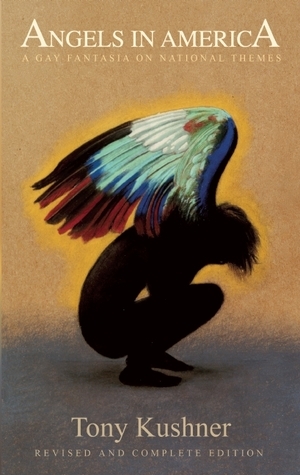 Publication: May 1 1993
Publisher: Theatre Communications Group
Pages: 333 pages (Paperback)
Source: Library
Genre: Fiction, Play, Queer, Classic, Magical Realism
My Rating: ⛤⛤⛤⛤⛤
Summary:
Prior is a man living with AIDS whose lover Louis has left him and become involved with Joe, an ex-Mormon and political conservative whose wife, Harper, is slowly having a nervous breakdown. These stories are contrasted with that of Roy Cohn (a fictional re-creation of the infamous American conservative ideologue who died of AIDS in 1986) and his attempts to remain in the closet while trying to find some sort of personal salvation in his beliefs. Read and performed for over twenty-five years, Angels in America remains a fixture of queer drama and literature, reiterating “The Great Work begins.”
 Sarah O'Connor